Israel Stopping All Aid To Gaza, Journalist Tells Sputnik

By Ian DeMartino – Sputnik – 13.05.2024
Last week, Israel seized the Palestinian side of the Rafah border crossing, the only entry point into Gaza not controlled by Israel and where the largest amount of aid was entering the Gaza Strip. Israel has halted all shipments entering through the Rafah border crossings and the nearby Kerem Shalom crossing, citing nearby fighting.
Israel has completely stopped all aid shipments going into Gaza, Lebanon-based journalist and geopolitical analyst Leila Hatoum told Sputnik’s Fault Lines on Monday.
“They control the whole area and… they have shut down all border crossings. Nothing has entered Rafah or Gaza for the past eight days. Israelis have shut down all borders,” Hatoum explained, citing her sources on the ground in Gaza.
“Nothing has entered Gaza, not even water, flour, medicine, children’s needs, baby formula, hygienic products. Nothing. Nothing whatsoever,” she emphasized.
On Monday, videos emerged on social media showing Israeli citizens destroying aid intended for Gaza on trucks waiting to cross the Tarqumiya checkpoint. There doesn’t appear to be any police presence attempting to stop the looters in the videos. According to media reports, four individuals were arrested at the scene.
“The aid that the State of Israel transfers goes directly into the hands of Hamas,” the organization that organized the blockade, Order 9, said in a statement.
 It was only the latest in a string of videos showing Israelis sabotaging aid trucks on their way to Gaza, another video released late last month showed Israelis destroying bags of flour, again without visible police resistance.
Israelis destroying the flour that was meant to feed starving people in Gaza.
Also on Monday, Israeli forces opened fire on an officially marked UN vehicle, killing one UN employee and injuring another. Later in the day, according to Israeli Rights group HaMoked, a group of young Israelis set fire to the perimeter of the UN Agency for Palestinian Refugees (UNRWA) headquarters in East Jerusalem. It was the second incident of arson at the headquarters this week.
UN Secretary-General, Antonio Guterres called for an investigation and condemned the attack on the UN vehicle. As of May 1, at least 182 UNRWA employees have been killed in Gaza.
At least 370,000 Palestinians have fled Rafah ahead of Israel’s promised ground war and continued bombardment of the last remaining refuge in Gaza, but many complain that there is no safe place to go.
“Every single place in Gaza, across [the] north all the way down to the south, is being bombarded by the Israelis,” Hatoum relayed. “Back in January and February we were warning that famine is going to hit north Gaza, people will die of starvation and nobody believed us, and then we started seeing people dying of starvation – children first and then others.”
At least 35,000 Palestinians have been killed since October 7, though that number is presumed to be a low-count as thousands of bodies are believed to remain under the rubble of destroyed buildings.
Shameless
By Craig Murray | May 13, 2024
Incredibly the Israeli genocide in Gaza is now reaching new heights of violence. Casualty figures are not coming in, as the attacks are so bad that bodies cannot be recovered, medics cannot travel and there are almost no medical facilities operational now anyway.
We now see that the Western injunctions not to attack Rafah were a smokescreen of lies to mask complicity. The final pocket of Gaza is being ruthlessly ethnically cleansed and its infrastructure will be destroyed like all the rest.
It is striking that this is accompanied by an absolutely shameless doubling down of support for Israel by the Western political and media classes. Any thought that their isolation from the vast breadth of public opinion would give them pause, must be abandoned. Their Zionist lobby paymasters have jerked the chain, and rather than rowing back, we are seeing a redoubling of their efforts to suppress dissent and obscure the truth.
Some of this shameless distortion is so dissonant with the alleged norms of Western society it is almost impossible to believe it is happening. Here are a few examples.
1) Dr Ghassan Abu Sitta is a highly respected reconstructive surgeon who continued to work heroically and tirelessly in Al Shifa hospital, carrying out operation after operation, mostly on women and children, as the hospital was shelled, strafed and machine gunned around him.
He was already a surgeon of great distinction, based in Glasgow where he is now Rector of Glasgow University.
When Germany banned him from entering to address the conference on Palestine from which Yanis Varoufakis and others were also barred, it appeared perhaps as a one-off action as part of Germany’s extreme and panicked reaction to pro-Palestinian expression.
We have come to understand that Germany has a vicious hatred of Palestinians, remarkably based on the psychological trauma of inherited guilt from the Holocaust. While this is a muddled national psychosis that is plainly immoral and wrongheaded, at least it is possible to have some understanding of how it occurred.

But it then turned out that the travel ban slapped on Dr Abu Sitta by Germany has a Schengen-wide effect as he was also banned from France. That appeared again something that was almost a technical accident as regards the rest of Europe.
But the Western political establishment has now doubled down again by banning him from the Netherlands, and this time the Dutch government has made it clear that it supports the ban, and is not just caught by a Schengen restriction.
So the major governments of the European Union are forbidding a distinguished surgeon from giving first-hand medical evidence of the genocide taking place. I cannot think of anything that more sharply exposes the willingness of the Western political class to abandon the most basic tenets of supposed “Western democracy” in the interests of Israel.
2) The willingness of the United States to use extreme violence against pro-Palestinian students on college campuses is another demonstration of the same abandonment of the pretence of democracy when it comes to Israel. It also illustrates what has come to be a serious generational divide in Western public opinion, with young people very strongly motivated to oppose the genocide (which is not to say that older people are pro-genocide, just that they are more split, particularly in the USA).
This is being followed up with yet more crazed pro-Israeli legislation in the United States, seeking to designate anti-genocide and pro-Palestinian expression on campuses as anti-semitic and thus illegal.
In many ways this typifies the reaction of the ruling class across the West. Their reaction to suddenly being exposed as the paid servants of an Israel which no longer has popular support and now causes public revulsion, is simply to attempt to ban free expression and make it specifically illegal to disagree with them.
3) The British Labour Party has gone even madder. Keir Starmer’s Genocide Party is an outstanding example of the success of the Israeli lobby in buying up both sides of the aisle and controlling the entire neoliberal uniparty that poses as the repository of democratic “choice” in the West.
Starmer had been doing his best to conceal his explicitly expressed “unequivocal support for Israel” lately, and to row back from his straightforward assertion that Israel has the right to cut off food and water from the population of Gaza. There had been a fake shift, from refusing to countenance the word “ceasefire” to supporting a temporary ceasefire or a “sustainable” ceasefire – the latter being code for a ceasefire after Israel had achieved all its ethnic cleansing objectives.
But then David Lammy blew this out of the water with an address to US Republican senators in which he made the totally bonkers assertion that Nelson Mandela would have opposed the college protests for Palestine. Lammy is a truly despicable individual, one of the ultimate examples of the corrupt politician whose voice is bought. But this was a move far beyond the pale.
4) Even today, the Western media continues to spout out Israeli propaganda at mains pressure. The Guardian, despite the thousands and thousands of dead women and children we have seen on our mobile phones this past seven months, continues to pretend that the genocidal attack is on “Hamas militants”.
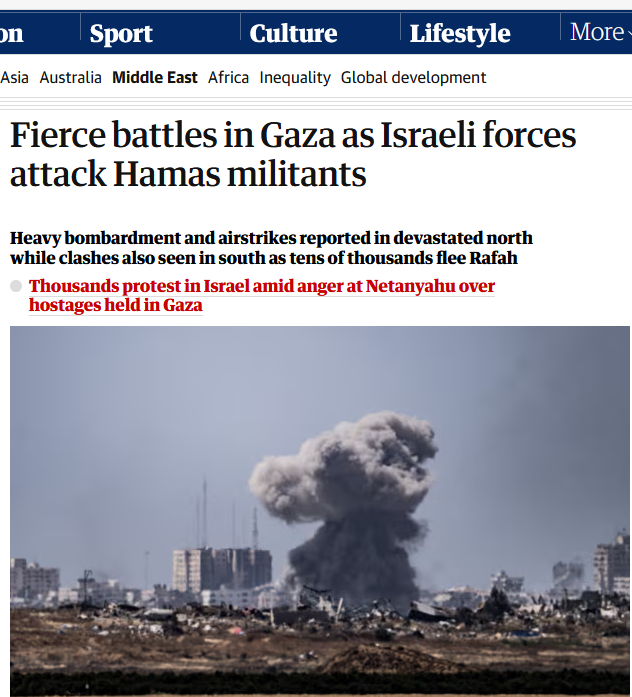
The bombing and shelling of civilians in tents is still described as “clashes”. This propaganda really does not wash any more, though it may reinforce the morale of hardened Zionists. Everybody else has seen through it months ago. Yet still they persist.
5) The endgame is becoming very apparent. The United States is completing its floating harbour for Gaza, and Israel has gained control of the Rafah crossing into Egypt, giving the US and Israel total control of entry points into Gaza. Israel has announced that the Rafah crossing is to be handed over to a US mercenary force. The US can then say it is complying with Biden’s pledge not to put US forces’ boots on the ground in Gaza, while actually taking control.
The Israeli attack on Rafah has been justified by the USA as a “limited military operation”, thus claiming it does not violate Biden’s purported “red line”, even though Israel has ordered over a million displaced people in Rafah to evacuate again, to nowhere.
Conclusion:
The only possible conclusion from all of the above is to reinforce my analysis that the Zionist political and media classes in the West, including Biden, Blinken, Trudeau, Macron, Sunak, Starmer, Scholtz, von der Leyen and all, are active and willing participants in a programme of genocide.
They had numerous opportunities to turn back. We all saw what is happening months ago. They did not take the opportunities.
The endgame remains the processing of the remaining Palestinian population out of Gaza through the US-controlled points of the Rafah crossing and the floating harbour, primarily into camps in the Sinai desert. The Western powers are doubling down on their genocide and on their colonial project.
I see nothing whatsoever that indicates they can have any other long-term objective in mind than the complete Israeli annexation of Gaza minus its civilian population. What do you see?
Only one power could stop Israel’s Rafah invasion – but it dropped the ball

By Robert Inlakesh | RT | May 13, 2024
Israel has been threatening a full-scale invasion of the Gazan city of Rafah for months, with the US government belatedly warning against the move and calling for a ceasefire. However, the Biden administration has consistently flip-flopped on the issue and refused to take serious measures to pressure Israel into reaching a deal.
On May 6, Hamas publicly announced that it had accepted a ceasefire proposal, triggering celebrations throughout Gaza. The rejoicing was short-lived though, as the Israeli government reiterated its refusal to accept a deal and pledged instead to launch a ground operation in Gaza’s southernmost city, despite US government objections.
Israeli Prime Minister Benjamin Netanyahu even stated that “the day after is the day after Hamas. All of Hamas,” meaning there is no ceasefire deal he will accept.
Despite the Israeli military capturing the Rafah Crossing between Gaza and Egypt, in addition to killing dozens of civilians after bombing 100 targets throughout Rafah, Israel announced that a delegation had been sent to Cairo to “exhaust” all possibilities of reaching a ceasefire. As it would later turn out, the ceasefire proposal that Hamas accepted was almost identical to one drafted by the CIA and Israeli intelligence, and lauded by US Secretary of State Antony Blinken as a “strong proposal”.
Meanwhile, in cities like Haifa and Tel Aviv, Israeli protesters – led by the families of captives held in Gaza – had taken to the streets to demand their government accept the ceasefire terms, which included the release of all Israeli prisoners. Clashing with the police and labeling the Netanyahu government liars, the demonstrators threatened to burn the country if their prisoners were not freed.
The US response the very next day was to gaslight reporters by telling them that the whole world was wrong and that Hamas had not accepted any ceasefire proposal. It was not long before US President Joe Biden was to sit down for an interview with CNN and state that he would not supply Israel with offensive weaponry to be used in a “major invasion” of Rafah. What he refused to do, however, was define what a major invasion means – and where the red line is.
This unclear approach comes after the Israeli military violated the terms of the 1979 Camp David agreement, which normalized ties between Egypt and Israel, by invading what is known as the Philadelphi Corridor in southern Gaza. Not only did the Israeli army send in its Givati Brigades, who published videos of themselves recklessly crushing the border crossing for fun, they also sealed off the key aid route to Gaza’s civilian population, who are on the brink of famine.
A weak and confusing American approach
The Israeli government has been threatening to invade Rafah since the start of the year, with Benjamin Netanyahu repeatedly asserting, since the beginning of February, that Israel will “lose the war” if there is no invasion. it’s a move that the US not only says will mean defeat militarily, but more importantly, threatens the lives of over a million civilians, most of whom have nowhere else to go.
In early March, Biden gave a confusing interview to MSNBC, where he repeatedly contradicted himself when addressing the issue of an Israeli invasion of Rafah.
While claiming that entering Rafah is a “red line,” he then said that “there’s no red line [where] I’m going to cut off all weapons… but there’s red lines that if he crosses them”, before he seemed to lose his train of thought.
The sudden changes in the stance of policymakers in Washington are not limited to Biden’s MSNBC interview. In early February, the US said it would oppose an invasion of Rafah, calling it a “disaster,” to which the Israeli prime minister responded that he was preparing his forces to invade – and ramped up aerial attacks on the area. Yet, in mid-February the US government prepared a $14 billion military aid package for Israel and would go on to say that it could only support a limited invasion of Rafah.
Then there were reports that emerged, citing unnamed US officials, alleging that Biden was growing frustrated with Netanyahu and that he had even sworn at him. There was then the American push towards a “six-week ceasefire” in March, which the US president publicly said he hoped would happen prior to the Muslim Holy month of Ramadan. Even now, the Biden administration is still talking about an alleged “six-week ceasefire”, despite its own proposal to Hamas being a detailed agreement designed to end the war or at least to last for several months.
Silently, the US approved over 100 weapons transfers to assist the war effort against Gaza, in which they used loopholes to avoid Washington’s own new laws on weapons sales. Then, with two weeks left until the end of Ramadan, the US finally abstained in a United Nations Security Council (UNSC) vote, which called on Israel to implement a ceasefire until the end of the Muslim Holy month. In response, Israel immediately canceled the pre-planned visit of a high-level American delegation to Tel Aviv.
However, the very next morning, following the passing of the UN Security Council resolution, the US State Department announced that the resolution was non-binding. This not only meant that Washington was denying the reality of the internationally understood consensus that all UNSC votes are by their nature binding, but also that it would allow Israel to violate the resolution. So, even though Washington technically took a measure to pressure its ally temporarily, the very next day it gave an informal veto of the resolution, signaling to the Israeli government that it would retain American support no matter what.
While admitting that an invasion of Rafah will inevitably lead to the mass killing of Palestinian civilians, and block humanitarian aid transfers during an impending famine, and that it will not lead to the collapse of Hamas or the return of Israeli prisoners, the US government is effectively twiddling its thumbs.
The US has had nearly seven months to formulate a coherent policy when it comes to its goals and red lines in the Gaza-Israel war, yet it cannot articulate what its red lines are – and what ceasefire it even desires – without constantly contradicting itself. Western corporate media are now pointing to the postponing of a singular weapons shipment to Israel by the Biden administration, as if this constitutes pressure. But the US has done nothing to force Israel to allow aid to pass through the Rafah Crossing, which it immediately called upon Israel to do.
At this point, the US government is not helping to achieve Israel’s publicly stated war aims, it is not helping the families of Israeli prisoners, and it has failed to achieve a ceasefire or the sufficient transfer of humanitarian aid into Gaza. Instead, Joe Biden appears to be doing one thing – helping Benjamin Netanyahu prolong the conflict, with no end goal, no exit strategy, and no political solution or even the most basic idea of a post-war situation on the horizon. If anything, the US government has proven itself to be incapable of playing any constructive role to any side’s benefit. In fact, it is detrimental to the situation. If there were any people of conscience left in Washington, they would be urging their colleagues to step aside and hand the issue over to nations with coherent foreign policy platforms and intelligent diplomats.
Robert Inlakesh is a political analyst, journalist and documentary filmmaker currently based in London, UK. He has reported from and lived in the Palestinian territories and currently works with Quds News. Director of ‘Steal of the Century: Trump’s Palestine-Israel Catastrophe’.
Israelis use Palestinian kids as human shields: Rights group
Press TV – May 12, 2024
A Geneva-based rights group has condemned the Israeli regime forces for using children as human shields in their assaults on Palestinians.
The Defense for Children International (DCI) said it heard testimonies of three children who described how they were used as human shields by occupying Israeli forces during a recent search and assault operation in the West Bank’s Tulkarm refugee camp, the Middle East Eye on Sunday reported.
The DCI said the Palestinian children said on May 5 and May 6 Israeli soldiers had forced them to walk ahead of them as they searched through the refugee camp, describing two instances in which the Israeli regime forces had placed their rifles on their shoulders.
One teen named Kareem recounted how Israeli forces stormed his family’s apartment on May 6 and then forced him to lead them through the apartment block as they carried out a search operation in the building. The teen said the soldiers had placed a loaded rifle on his shoulders and fired two shots toward one of the apartment’s entrances.
Another child, Mohammad, said during a raid on his home, he was forcibly separated from his family by the Israeli forces.
“I remained alone with the soldiers after they instructed my mother and siblings to climb to the fourth floor of the building. I started crying and trembling with fear because I didn’t know what they would do to me. They were armed, masked, and their appearance was terrifying, accompanied by a large police dog making frightening noises,” Mohammad said.
He said they told him to knock on each apartment door in the building and tell the residents in the apartments to leave their homes.
Mohammad said if an apartment was empty and no one answered, the armed men would enter by force.
“When we reached the door of one of the apartments and found it empty, the soldiers blew up the door and forced me to enter alone to inspect it,” said the Palestinian child.
Ibrahim, another Palestinian teen, recounted how on the morning of May 6, Israeli forces stormed his family’s home in the Tulkarm refugee camp in a “brutal and terrifying manner,” searching and vandalizing their belongings.
He said, “A group of soldiers took me to one of the rooms and began interrogating me. When I told them I knew nothing, one of them threatened me in Arabic and said (I’ll smash you if you don’t talk). Then he physically assaulted me for several minutes before handcuffing my hands behind my back with a plastic tie. They then took me outside and asked me to walk in front of the soldiers.”
“I was trembling with fear and terror. At first, I thought they wanted to arrest me, but they asked me to walk in front of them in the alleys of the Al-Sawalme neighborhood in the camp. They would hide in the alley and ask me to show the way. After that, they released my hands, and every time we passed by a house or building, they would ask me to enter and ask the residents to leave and head towards the soldiers, after which they would raid those homes. During the raids, they would ask me to open the internal doors of the houses and apartments.”
Ibrahim said after about two hours of searching the camp, the Israelis took him to a house in the camp where he was detained alongside others until the Israeli forces withdrew from the camp.
 In the meantime, the use of Palestinians as human shields by Israeli regime forces in numerous cases has been well documented by multiple human rights organizations.
Israeli regime forces put Palestinian civilians in front of them or otherwise put civilians in the line of fire, and force them to open doors that could be booby-trapped or remove suspicious objects that might be bombs. They also force them to walk through suspected booby-trapped buildings.
The Zionist forces also often employ the “neighbor procedure” in which Palestinian civilians are forced to attempt to persuade individuals to leave or surrender themselves.
“International law is explicit and absolutely prohibits the use of children as human shields by armed forces or armed groups,” said Ayed Abu Eqtaish, Accountability Program director at the DCIP, adding, “Israeli forces intentionally putting a child in grave danger in order to shield themselves constitutes a war crime.”
For decades, both Palestinian children as well as adults have been used by the Israeli forces during operations as human shields.
The use of civilians as human shields is one of many war crimes committed by the Israeli regime forces.
Unremarkable peer recruited by Zionist lobby to stop Palestine Action
By Yvonne Ridley | MEMO | May 13, 2024
Despite posing as an “independent” government advisor, Woodcock is affiliated with the pro-Israel lobby and the arms industry. He is also the chair of the Defence Purpose Coalition, which brings together senior figures within the arms industry to promote its deadly products. Since 2011, he’s travelled to Israel on numerous occasions on trips paid for by the Israeli government and pro-Israel lobby groups, according to a recent investigation by Declassified UK.
Hamas slams Biden for linking Gaza cease-fire to hostage release

MEMO | May 12, 2024
Hamas on Sunday criticized US President Joe Biden for linking a Gaza cease-fire to the release of Israelis held captive by the Palestinian group, Anadolu Agency reports.
Biden said Saturday that a cease-fire in Gaza would be possible as soon as “tomorrow” if Hamas released Israelis in its captivity.
This position “is a regression from the results of the last round of negotiations, which led to our approval of a proposal drawn by mediators in Egypt and Qatar, with the US knowledge,” Hamas said in a statement.
Last week, Hamas, which is believed to be holding nearly 130 Israelis following its Oct. 7 cross-border attack, accepted a proposal drawn by Egypt and Qatar for a cease-fire in Gaza.
But Israel said the truce offer did not meet its key demands and decided to push ahead with an operation in Rafah, home to more than 1.5 million displaced people, to apply “military pressure on Hamas with the goal of making progress on freeing the hostages and the other war aims.”
Hamas said it has shown flexibility during all rounds of negotiations to reach a cease-fire deal in Gaza.
“However, terrorist [Israeli Prime Minister Benjamin] Netanyahu and his government rushed to overturn this path by launching their aggression on our people in Rafah, Jabalia, and Gaza,” it added.
“Biden’s position once again confirms the US bias towards the criminal policy” pursued by Israel and shows “its continued political cover and military support for the genocide waged against our people,” Hamas said.
More than 35,000 Palestinians have been killed and over 76,600 others injured in a brutal Israeli onslaught on the Gaza Strip since the Hamas attack that killed nearly 1,200 people.
The Palestinian group demands an end to Israel’s ongoing military offensive on the Gaza Strip in return for any hostage swap with Tel Aviv.
More than seven months into the Israeli war, vast swathes of Gaza lay in ruins amid a crippling blockade of food, clean water and medicine.
Israel is accused of genocide at the International Court of Justice (ICJ). An interim ruling in January said it is “plausible” that Tel Aviv is committing genocide in Gaza, ordering it to stop such acts and take measures to guarantee that humanitarian assistance is provided to civilians in Gaza.
South Africa on Friday asked the ICJ to order Israel to withdraw from Rafah as part of additional emergency measures over the war.
How hawks in US are trying to demonize students protesting Israeli genocide
By Mohsen Badakhsh | Press TV | May 12, 2024
The US government has resorted to brutal measures not only to suppress the growing student movement in colleges across the country against the US-backed Israeli genocide in Gaza but also to demonize it by labeling protesters as “criminals” and “terrorists.”
Such oppressive measures – by a country that routinely uses its propaganda machinery to project itself as the “leader of the free world” – evoke familiarity as Washington has always falsely accused countries, organizations and individuals critical of its hegemonic policies of such measures.
In the past week, many American lawmakers across the political spectrum have labeled these protesting students and professors at America’s most prominent universities as Iran-backed “terrorists”, “pro-Hamas fanatics” and “criminals,” while referring to the traditional Palestinian keffiyehs as “terrorist headdress” and the protest encampments on college campuses as “little Gazas.”
Such racist and derogatory language against Palestinians as well as American critics of Washington’s military and economic support for the Israeli apartheid regime and the ongoing Gaza genocide was employed by members of the US Congress at the behest of the powerful pro-Israel lobby.
Take note of the following remarks by Republican Senator Tom Cotton of Arkansas made last week while introducing legislation to cut off federal funding of universities that have not done enough to suppress student protests against the persisting US-Israeli genocide in Gaza.
“We’re here to discuss ‘little Gazas’ that have risen upon campuses across America and liberal college administrators and politicians who refuse to restore law and order and protect other students. These ‘little Gazas’ are disgusting cesspools of anti-Semitic hate — full of pro-Hamas sympathizers, fanatics and freaks,” Cotton stated.
“The terrorist sympathizers in these ‘little Gazas’ aren’t peacefully protesting Israel’s conduct of the war. They’re violently and illegally demanding death for Israel, just like their ideological twins: the ayatollahs in Iran,” he hastened to add, trying to connect the pro-Palestine campus movement to Iran.
Such remarks point to Washington’s long-held strategy of linking Iran, a country that has dared to challenge the Western hegemony, to any meaningful criticism of its Israeli ally while falsely depicting the Islamic Republic and resistance groups as instigators of terrorism and human rights violations.
This is while top American officials have admitted to establishing, enabling and funding the world’s most notorious terrorist groups – such as Daesh (ISIS) – to wage wars of terror and destabilize countries such as Syria, Iraq, Afghanistan, Yemen, Somalia, Libya, Cuba, Venezuela and Nicaragua.
Washington has also earned notoriety for waging military coups to topple popular governments and install ruthless dictators to push their interests in different regions, including Iran, all in the name of “democracy” and “rule of law.”
Joining the hawkish Arkansas senator in sponsoring the so-called ‘Bailouts for Campus Criminals Act’ were 18 other Republican senators that likened peaceful student protesters to “terrorists” and “criminals” just for taking a stand against US support for the Israeli regime’s genocidal war on Gaza.
“Hamas sympathizers engaging in criminal behavior on college campuses should be ineligible for student loan bailouts,” said Republican Senator Marsha Blackburn of Tennessee who co-sponsored the bill.
“We must hold these criminals accountable and ensure taxpayer dollars do not go toward paying off their debt,” she added, while having no word on billions of dollars worth of weapons sent to Tel Aviv by US President Joe Biden that are used to slaughter Palestinian children and women.
Meanwhile, Republican Senators Mitch McConnell of Kentucky, Rick Scott of Florida, Joni Ernst of Iowa, Bill Hagerty of Tennessee, and others also demanded a freeze on federal funding for US universities that have not done enough to condemn and punish student protesters.
The move also signifies that major US higher education institutions rely heavily on federal funding and are expected to abide by Washington’s policies, including its support for genocidal war crimes in Gaza.
Unfazed by the hostile and repressive crackdown on student protests at major American universities, teenage high school students in numerous US cities have started their own protest rallies against Washington’s ironclad support for persisting Israeli war crimes across occupied Palestine.
The emergence of the new protest movement led by the younger American student community in major US states such as New York, California, Illinois, Texas, Oregan, Maryland and Washington clearly points to the futility of harsher measures taken by US officials aimed at deterring and punishing any opposition to its oppressive policies – nationally as well as through foreign interference.
The development has raised new fears among US politicians and analysts about likely repercussions in the presidential and congressional elections next November for both political parties amid concerns about a potential upheaval and violence in the rematch presidential race between the 82-year-old Biden and the 80-year-old former president Donald Trump.
Moreover, a dozen American senators have also issued strongly-worded warning to the International Criminal Court (ICC)’s chief prosecutor Karim Khan against the UN court’s possible handing of arrest warrants against the Israeli regime officials over their persisting genocidal war on the Gaza Strip.
“Target Israel and we will target you,” vowed pro-Trump Republican senators that included Tom Cotton, Mitch McConnell, Rick Scott, Tim Scott, Ted Cruz, and Marco Rubio.
The move came amid speculation that the court may issue arrest warrants against top Israeli officials over the genocidal war in Gaza that has so far killed nearly 35,000 Palestinians, mostly women and children.
Also this week, the largest American Muslim civil rights and advocacy organization slammed the US House of Representatives for passing a controversial legislation that criminalizes any criticism of the Israeli apartheid regime.
In a statement released on Wednesday, the Council on American-Islamic Relations (CAIR) insisted that the so-called ‘Antisemitism Awareness Act of 2023’ is a “one-sided, and dishonest” document that ignores persisting anti-Palestinian racism across the United States.
The House approved the bipartisan bill, introduced by New York Republican Congressman Mike Lawler, in a 320-91 vote and forwarded it to the Senate for passage and likely enactment by Biden’s signature.
Pointing to Washington’s traditional support for persisting Israeli atrocities against the Palestinian population, the Leader of the Islamic Revolution Ayatollah Seyyed Ali Khamenei reiterated earlier this month the validity of Tehran’s distrust of the US and rejection of the apartheid Zionist regime, citing American complicity in Israel’s genocidal war on Gaza and its brutal crackdown on student protests.
Ayatollah Khamenei declared that the only solution to the Palestinian issue would be the return of the entire land to its rightful owners and allowing them to decide what to do with the Zionist occupiers.
He further pointed to the expansion of the American student protest movement to universities across Europe and other parts of the globe, insisting that “Gaza remains the leading concern of the world” with a growing realization about the evil nature of the Zionist regime as well as the validity of the Islamic Republic’s unrelenting policy of rejecting the legitimacy of the Israeli occupying entity.
It remains to be seen what Washington’s defiance of the growing worldwide condemnation of Israel’s genocide in Gaza will spell for it in a highly sensitive election year in the face of a very divisive Congress and persisting tensions with Russia, China and the West Asia region over various military, political, economic, and strategic issues.
Mohsen Badakhsh is an educator and freelance journalist.
Calling out UK for its brazen protection of pro-occupation forces
By Hannan Hussain | Al Mayadeen | May 12, 2024
The protests are spreading.
From Oxford University to Edinburgh, students in considerable numbers are pushing academic institutions in the United Kingdom to end ties to the Israeli occupation. As the genocide reaches devastating highs in Gaza, many faculty and staff members are on-board to push for divestment demands and are calling out the Israeli systemic campaign of mass slaughter and starvation.
But that same sense of aversion to Israeli genocide and war crimes appears absent among UK policymakers, who quietly cheerlead Israeli belligerence. According to damning new revelations, the Conservative Party of the UK has consistently catered to the pro-genocide occupation by protecting Israeli politicians, spy agents, and other officials from glaring war crimes. These developments reveal the extent of London’s complicity in the Israeli-led genocide, and illustrate the use of “special” immunity to protect war criminals that have Palestinian blood on their hands.
Consider Israeli war criminal General Herzi Halevi, among the chief architects of a planned Israeli onslaught on Rafah. Rather than joining international momentum to support prosecution of Halevi and his allies, the UK granted the war criminal a visiting permit without fear of arrest. These are glaring examples of Britain deluding the public on legal rights, and twisting its own laws to enable support and protections for a genocidal regime.
London is thus unqualified to offer rhetoric against Israeli offensives when it consciously sustains its partisan support for the same occupation. Andrew Mitchell, the UK’s deputy foreign minister, put on a false show of morality this week, claiming that an Israeli ground invasion of Rafah would ‘break international humanitarian law.’ Lets be clear: the UK doesn’t care about international law or the astounding scale of Palestinian suffering and mayhem. Mitchell even refused to spell out any meaningful consequences for the occupation in the event of a full-scale invasion, exposing the cosmetic nature of British rhetoric on Gaza.
The British government is also wrong to give the benefit of the doubt to a genocidal regime by claiming that international humanitarian law was about to come under threat. Britain’s stance on Gaza should be condemned for deluding the public because “Israel” has been breaking international law from the outset and for decades. It is evident in a process of systemic Israeli annihilation, mass slaughter and glaring war crimes that London’s own diplomacy justifies in practice.
At a time when the International Criminal Court (ICC) has occupation premier Benjamin Netanyahu and his allies fearing arrests and isolation, Britain appears determined to obstruct justice and do “Israel’s” pro-genocide bidding. After all, it is a country that Amnesty International has declared a “deliberately destabilising” force for human rights on the world stage, and proves that point by allowing Israeli war criminals to visit without fearing arrest. Make no mistake: Britain is seriously unqualified to speak to any semblance of democratic values because its pro-occupation tilt signals violation of British commitments to universal jurisdiction laws. That includes the Rome Statute which holds that the most serious crimes are tried regardless of where they occurred.
Palestinian rights groups are absolutely correct to turn the heat on London and hold it accountable for its own breaches of international law in Gaza. This includes the West Bank-based Al-Haq, which is taking Britain to court over arms exports funding the genocide. As UK’s diplomatic “immunity” becomes the latest weapon to shield Israeli war criminals, it is in the interests of Britain-based activists and their international counterparts to form a legal challenge of their own. This is imperative to hold the government accountable for sponsoring pro-genocidal forces under the garb of diplomacy.
London’s denial would carry zero weight because its support for Israeli war criminals is rooted in history. Look back to 2011 when Labour chief Keir Starmer blocked arrest warrant prospects for occupation foreign minister and suspected war criminal Tzipi Livni. A government so deeply in cahoots with a decades-old Israeli military occupation cannot be trusted to drive accountability from within. London’s contribution to more Palestinian bloodshed thus demands that the government is tried with the full force of the law.
There is also a common thread that binds escalating anti-genocide protests across Britain: the truly urgent situation for besieged Palestinians in Gaza. The Israeli occupation continues to launch airstrikes in Rafah and pursues a systemic campaign of civilian massacres that is now centered around the southernmost Gaza city. And yet, Britain played a principal role in aiding “Israel’s” genocide capacities on the intelligence front ahead of time. That includes 50 British espionage missions that were conducted since the start of December with the principal goal of aiding the occupation.
With these realities in mind, how can Britain even stand up to the international community and tout the occupation’s so-called “truce” proposal as generous? There are striking double standards in the way UK plays up public rhetoric on peace and prosperity over Gaza, while profiting from its bloodshed.
Its broader occupation support through information-gathering, espionage, diplomatic immunity, and weapon supplies firmly establish complicity in the ongoing genocide.
The Declassified UK revelations are only the tip of the iceberg.
Israel carpet bombs Gaza with no goal in sight
The Cradle | May 12, 2024
Dozens of Palestinian civilians have been killed and injured over the past 24 hours by intense Israeli bombardment across the Gaza Strip.
Israeli airstrikes have continued to relentlessly bomb northern, central, and southern Gaza.
“18 martyrs and six wounded were admitted to the Kuwait Hospital” in the southern city of Rafah, medical sources told WAFA news agency on 12 May. Children were among those killed by Israeli strikes on Rafah.
“Israeli tanks opened fire on civilian homes in the eastern areas of Deir al-Balah and Maghazi,” WAFA added.
Israeli artillery shelling pounded Gaza City’s Al-Zaytoun neighborhood, in the north. Over a dozen civilians remain trapped under the rubble there, according to WAFA. Several civilians were also killed in bombing of northern Gaza’s Jabalia.
An Israeli quadcopter opened fire at UNRWA clinic in the Jabalia refugee camp.
“Our emergency crews are receiving many calls for help,” said civil defense spokesman, Mahmoud Basal, adding that it is “gravely difficult and dangerous for the civil defense crews to aid civilians because they themselves have no immunity and are targeted by Israeli occupation forces.”
The intensified bombardment comes as Israeli troops are engaged in fierce clashes with the Palestinian resistance in northern Gaza.
Hamas’ Qassam Brigades struck Israeli forces with heavy-caliber mortar shells in Al-Zaytoun neighborhood on 12 May, the group said in a statement.
On 11 May, intense clashes reignited in Al-Zaytoun, months after Tel Aviv claimed Hamas had been defeated in the north of the enclave. The Israeli army has also deployed to the city of Jabalia north of Gaza City, where it now says fighters from Hamas’ armed wing have regrouped.
The Qassam Brigades have also continued to fiercely confront Israeli forces operating in the southern city of Rafah, where the army launched a recent operation to seize the border crossing with Egypt. Tel Aviv had been claiming for months that Rafah is Hamas’ final stronghold, despite its continued presence, along with other factions, across the strip.
Rocket barrages have been flying out of Rafah toward the positions of Tel Aviv’s forces and nearby settlements over the past two days.
“Hamas has military capability and it will remain, and we will not end it if we continue fighting,” former head of Israel’s National Security Council, Giora Eiland, said on Saturday.
Pro-Palestinian protests grow at UK college as Sunak seeks crackdown
Al Mayadeen | May 11, 2024
Around thirty demonstrators continue their pro-Palestinian encampment for the third consecutive night as similar encampments have recently emerged on approximately 15 university campuses across the UK.
These student activists are urging their universities to divest from “Israel” in objection to its ongoing genocide in the Gaza Strip. It is worth noting that divestment involves the selling off of stocks in Israeli companies or cutting financial ties in other manners. Additionally, they are demanding an immediate ceasefire in the besieged region.
Despite the peaceful demonstrations at Cambridge and various other UK campuses, Prime Minister Rishi Sunak convened with university leaders at his Downing Street offices on Thursday, reportedly attempting to prevent the surge of pro-Palestinian protests similar to those witnessed in the US in recent weeks.
In the same context, Sunak’s office extended invitations to vice-chancellors from several leading UK universities to address measures aimed at combating the “anti-Semitism” weapon of choice on campus.
As a part of these efforts, Sunak unveiled plans for the government to allocate an extra £500,000 ($623,000) to bolster the University Jewish Chaplaincy Service, aimed at providing support to Jewish students.
Accusations of a rise in antisemitism reflect a broader trend observed not only in the UK but also across Europe and the US. This trend appears to be part of efforts aimed at quelling pro-Palestinian student activism and uprisings on campuses.
It is worth noting that the charges of anti-semitism have been rampant in Western media in an attempt to silence pro-Palestine positions or any denunciation of the war on Gaza unleashed by the Israeli occupation.
Instead of upholding their students’ rights to peaceful protest and fostering an environment conducive to freedom of speech, the UK government opted to crack down on student demonstrators.
Featured Video

STEVE KIRSCH: THE COVID JAB AND VACCINES IN GENERAL
or go to
Aletho News Archives – Video-Images
Interview
Interview with Jennifer Bilek
On The Transgender Agenda
Lies are Unbekoming | May 12, 2016
I’ve been following Jennifer Bilek’s reporting on the Transgender Agenda for the last year.
In my opinion, she is doing the best investigative journalism, in the world, on the top-down nature of this society deforming “input” and “normalization”.
What we don’t understand is the scale of money behind this push, and the individuals controlling this weaponized capital. These are questions that go to the heart of Jennifer’s work. … continue
Blog Roll
Recent Comments


 Aletho News
- NATO boss attacks China over Russia ties
- Israeli forces killed 8-year-old Ritaj’s family
- Global Temperatures and Reduced Cloud Cover
- Israel Stopping All Aid To Gaza, Journalist Tells Sputnik
- Shameless
- Only one power could stop Israel’s Rafah invasion – but it dropped the ball
- Israelis use Palestinian kids as human shields: Rights group
- Unremarkable peer recruited by Zionist lobby to stop Palestine Action
- 360,000 flee Rafah due to Israel strikes: UNRWA
- Iran, India move forward with port deal in face of US sanctions
- If Americans Knew
- Who’s Funding AIPAC’s Political Spending Barrage?
- For Columbia and a Powerful Donor, Months of Talks and Millions at Risk
- Columbia crackdown led by university prof doubling as NYPD spook
- Disaster unfolds all over Gaza, West Bank – Day 219
- Israeli airstrikes in southern Gaza, invasion in central Gaza, carpet bombing in north – Day 218
- Strapped down, blindfolded, held in diapers: Israeli whistleblowers detail abuse of Palestinians in shadowy detention center
- Fighter jets, attack drones hammer Rafah; catastrophe looms – Day 217
- What it’s like to be used as a human shield by the Israeli army
- Detailed study finds 99% of pro-Palestine protests at US universities are peaceful
- VIDEO: Armenian Christians under siege by Israel
- Richie Allen
- The Richie Allen Show Returns Tomorrow Wednesday April 24th
- Call Richie Today Monday March 11th From 4.30pm
- Connect To The Richie Allen Show WhatsApp Today
- NHS Asks Patients To Choose From 12 Genders, 10 sexual Preferences & 159 Religions
- The Richie Allen Show Moves To A New Time Slot From Monday Nov 20th
- Starmer Will Sack Shadow Ministers Who Vote For Gaza Ceasefire
- AI Tool Can Predict Heart Attacks Years In Advance
- Nepal Bans TikTok To Preserve Social Harmony
- Bloke Appointed Boss Of Womb Health Charity
- WHO – “Gaza’s Biggest Hospital Becoming A Cemetery”
- No Tricks Zone
- Using Nets On The Seafloor To Retrieve Seafood ‘Roughly The Same As Running 100 Coal-Fired Plants’
- New Paper: Global Warming Leading To HIMALAYAN COOLING, Preventing Glacial Melt!
- DNA Evidence Reveals Domestic Cats, Dogs, African Wildcats, Frogs Lived In The Arctic 9000 Years Ago
- -80°C: Antarctic Vostok Station Records “Extreme Winter Cold”…Not Even Winter Yet!
- The German E-Vehicle Nightmare, 2024 Q1 Sales Plummet 14%… “Graveyard” For Unsold Cars
- Newly Discovered 90,000-Year-Old Human Footprints Reveal How Much Higher Sea Levels Used To Be
- Germany’s Economic Bloodbath Worsens As Green Revolution Causes Economy To Bleed To Death
- Water Vapor Absorbs 84 Times More Radiation Than CO2 … Clouds Drove 89% Of 1982-2018 Warming
- The 97% Consensus Claim Is In Fact 97% Bogus
- Post-1980s Increases In Shortwave Radiation Explains Europe’s Warming Trends Far Better Than CO2
 Aletho News